Why Is Salt Used to Preserve Beef Jerky
I like to cook. I sometimes write about the foods of Costa Rica, and sometimes share one of my own unique dishes.
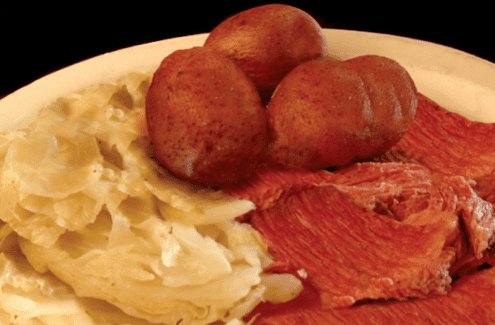
Typical Irish gaelic dinner: Corned beef is a delicious form of salt-preserved meat. Making your own isn't difficult.
Photo by A1stopshop, Public Dominan, via Wikimedia
How to Salt Meats for Preservation and Season
There are several processes that accept been developed for the preservation of meats over the centuries.
- Beef jerky is a dried form of meat that is salted in various ways before it is dried.
- Hams are also salted as part of the curing process.
- Corned beef is fabricated from brisket that is soaked for about a calendar week in a pickling alkali which tin take several different recipe variations.
- Sausage-making is as well dependent on salts equally a office of the curing and preservation procedure, equally are sandwich meats.
Hither, I talk over these processes and talk virtually the basics of preserving meats with salt. I describe several specific methods for preparing dried meats and meats seasoned in pickling solutions to provide you with the means of making your own.
Salt Preservation Basics
What kind of salt should I utilise to preserve meats?
There are several salts that are used to cure, or preserve, meat. Sodium chloride, ordinary table salt, is the primary ingredient, helping create an environment where bacteria cannot grow and removing wet inside. Simply other salts are needed to complete meat preservation. These salts are nitrates and nitrites. If nitrates and/or nitrite salts aren't used, then the fats inside the tissue will oxidize, or get rancid. Thus, it is important that nitrites are used. And, they are used in very small amounts in curing salt mixtures.
What does the salt practise to the meat?
Obviously, in addition to preservation, these salts add flavor. The common salt flavor would be apparently if the nitrates and nitrites were not present. These preservatives also make the meat plow pink to red and besides contribute to flavor. They are the reason corned beefiness is crimson. Various forms of sugar are likewise frequently added to enhance flavor, and sometimes ascorbates are added to pickling brines to speed up the curing process and stabilize the color given by the nitrates and nitrites.
Why does common salt preserve meat?
As common salt levels increase in a solution, the growth potential and survivability of microorganisms like fungi and bacteria decreases. At the recommended levels for dry salting and pickling, microbial growth doesn't occur. It is well known that proper table salt preservation prevents contamination by Clostridium botulinum, the bacterium that causes the fatal disease known equally botulism.
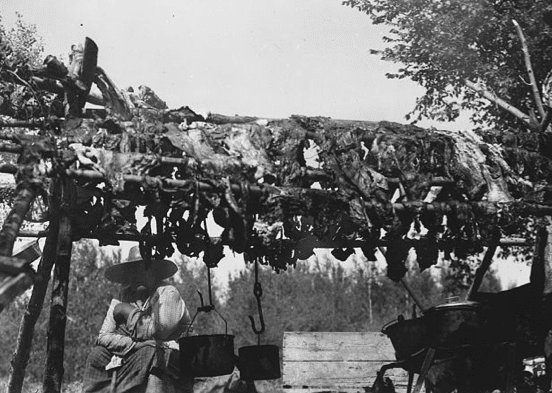
Drying meat is an historic period-old tradition for meat preservation. Table salt helps speed the curing procedure and prevents meat spoilage.
U. S. Dept. of the Interior, Public Domain, via Wikimedia
How to Prepare Meat to Be Salt-Cured
Utilize lean meat.
Before you get started in any of the processes mentioned below, make note that y'all need to apply cuts of meat that have very little internal and external fatty. The reason that you lot need to use lean cuts is to limit the amount of fat, which cannot be penetrated by the common salt solution. So, fat in non-lean cuts will oxidize, or become rancid.
Which cuts of meat are best for curing?
- Beef. Cuts of beefiness that are lean enough to be used include the brisket and round.
- Pork. Cuts of pork that are used normally include the ham, shoulders and belly, and sometimes, the loin and white jowl.
E'er allow meat to cool before salt curing.
Cooling the meat down to 32-35 degrees Fahrenheit earlier going through the salting helps prevents deterioration processes from first in the meat.
Scroll to Continue
Read More From Delishably
What temperature is best for curing meat?
The optimum temperature will vary co-ordinate to the blazon of curing you are doing.
- Large cuts: For large cuts of meat, like roasts, hams and shoulders, a temperature range of 35 to l degrees Fahrenheit is recommended (for external salt cures).
- Corning beef: For corning beef, refrigerator temperatures are needed.
- For jerky: For drying beef cut into strips, the temperature for smokers is given below. If drying is done in the sun or over a burn, warm, dry out temperatures can dry out the meat in a matter of hours. Humid outdoor environments are not recommended for drying, regardless of the temperature.
How to Cure Meat With Salt or Brine Solutions
There are two ways to utilize common salt for curing of meat: by using a brine solution or rubbing the salt on the surface. And y'all tin can either dry it in the sun or in a smoker. These methods are described below, with step-past-footstep instructions.
How to Dry-Cure Brined Meat in the Lord's day
- Prepare a 14% solution of pickling salt. If you lot wish to add sugar for flavor, use 11% salt and 3% chocolate-brown sugar.
- Cut lean meat into strips that are well-nigh one-half an inch thick.
- Soak them in the brine solution for five minutes. This brine solution can be re-used during the curing procedure for one 24-hour interval.
- Place the soaked strips in a colander and allow to drain.
- Append the meat strips on a line using either S-shaped hooks made of stiff wire, by tying up ane end with twine or by use of metal clips.
- Drying takes from 2-3 days in a dry, sunny climate. Ideal drying conditions are at thirty% or less relative humidity and with a flow of warm air that stays virtually the same temperature through the process. Screened cages are recommended to ward off insects.
How to Use a Smoker to Dry Cure Meat
A smoker is the preferred style to dry out the meat in humid climates. Follow steps 1-4 above and then place the meat on the grill surface of the smoker. Rut the smoker to between 100-120 degrees Fahrenheit. The process takes from 12-24 hours.
How to Dry-Cure Meat by Rubbing Information technology With Salt
This method is good for hams, shoulders and roasts. Pickling salt is rubbed on the meat to facilitate curing, just sometimes spices are added to enhance the flavor, like cracked peppercorns, mustard seeds or fresh herbs like rosemary, basil or sage. These spices are showtime rubbed onto the surface of the meat and and so the salt is applied.
The amount of salt that is needed is 1 i/2 cups per pound of meat, with one-half of information technology practical at the beginning of the process. The meat is hung in a room having temperatures betwixt 35 and fifty degrees F. (protected from insects) and 4-5 days later the rest of the salt is rubbed onto the surface. It takes almost 5 days for each inch thickness of the cut of meat to cure if it has no os. For meat containing bones, add together ii more days to the curing time for a total of seven days per inch.
Funny Bacon-Making Video
My Recipe for Bootleg Corned Beef
Corned beefiness is fabricated in a pickling solution, and the recipe is simple plenty that anyone can do information technology. If you accept the infinite in your refrigerator to store it while in the procedure of pickling, you lot can do it. Hither are the steps yous demand to follow.
- Buy a 4-lb cut of brisket and cutting off whatever backlog fat.
- Brand the brine solution. A half gallon of the solution consists of ane cups of pickling salt (or a mixture of Kosher salt and saltpeter described above, ane 1/ii teaspoons of pickling spices (crushed to release the flavors) and quarter a cup of packed dark-brown sugar. To the spices, you may want to as well add a piffling powdered or fresh ginger and/or a little cinnamon, depending on your taste preferences. Encounter the suggestion below, also.
- Boil the brine/spice solution briefly and let it cool to refrigerator temperature.
- Place the brisket in a plastic container or a large freezer handbag and add together the brine/spice solution. Put it in the refrigerator and plow the meat or the freezer pocketbook over every day. The meat will be ready after 7 days of brine treatment.
- Remove the meat from the bag or plastic container and wash off the alkali and spices before you cook it.
You tin substitute some of the water in the pickling solution with beer if you wish. But make sure that the volume of liquid remains the same.
Video Tutorial for Making Corned Beef, Role I
Video Tutorial, Function 2
Source: https://delishably.com/meat-dishes/How-to-Preserve-Meat-with-Salt#:~:text=Why%20does%20salt%20preserve%20meat,microbial%20growth%20doesn't%20occur.
0 Response to "Why Is Salt Used to Preserve Beef Jerky"
Post a Comment